
Jeju is often introduced through its slower rhythms: volcanic landscapes, tangerine farms, coastal villages, and café-lined roads shaped by sea winds.
But increasingly, the island is also becoming something else entirely: a real-world laboratory for future mobility and smart island technology 🌋🛰️
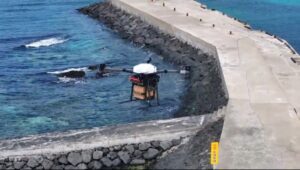
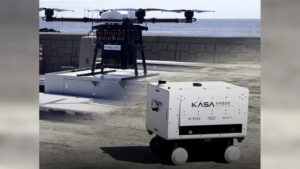
Recently, South Korea tested a fried chicken delivery system between Jeju’s Geumneung Port and Biyangdo Island, a small island located off Jeju’s western coast. The pilot project combined a heavy-lift drone capable of carrying up to 40kg with a four-wheel autonomous delivery robot.
The process itself sounds almost cinematic:
- customers place orders through a local delivery app,
- drones transport food and supplies across the sea,
- autonomous robots complete the final doorstep delivery journey.
International media quickly picked up the story, with one outlet describing it as: “South Korea tests fried chicken delivery to Biyangdo Island, Jeju using a drone and four-wheel robot in the world’s most elaborate takeaway operation. A vision of the future we can all get behind.”
While the fried chicken headline naturally grabbed attention, the broader significance lies elsewhere.
Jeju is increasingly being positioned as a “living lab” for emerging technologies including:
- drone logistics,
- autonomous mobility,
- smart tourism systems,
- and sustainable island transport infrastructure.
Its geography makes it uniquely suited for these experiments. As an island with smaller offshore communities, tourism-heavy traffic flows, and strong renewable energy ambitions, Jeju offers an ideal environment to test technologies that may eventually scale across other regions.
In other words, beneath Jeju’s image as a healing destination lies another identity quietly taking shape: a volcanic island where tourism, lifestyle, and future mobility are beginning to intersect.